For business success and continuity, it is essential to choose the most effective engagement model when collaborating with any software development firm.
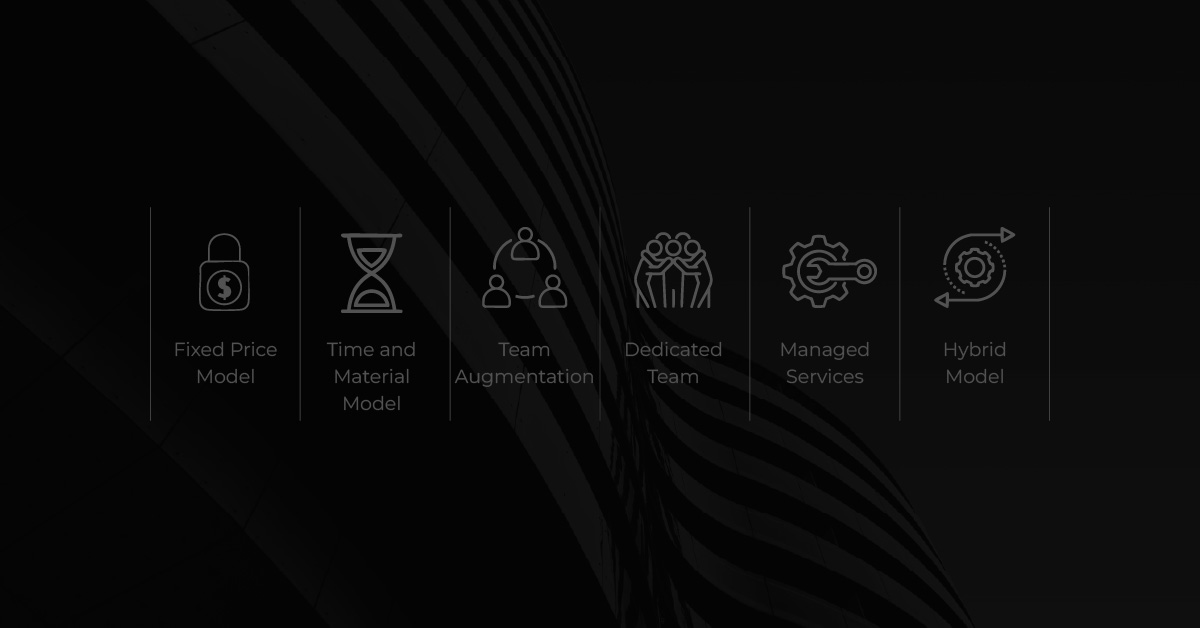
To drive the success of any software development project selecting the best engagement model is crucial for every organisation to identify the most effective frameworks which align with their business goals, as it defines the framework for deliverables, communication, collaboration, management, pricing, and other aspects of the partnership. There are various engagement models to choose from.
Commonly- used Engagement Models for Business Success
Fixed Price, Fixed Scope Model
This approach presents a contract that outlines the project’s scope, timeline, and mutually agreed price between the client and the development firm. This approach is most suitable for short-term agreements with a clear budget, where alterations to the project are not expected, as these modifications could result in financial consequences, especially when the client has a precise vision and specific goals. Organisations that are most compatible with this model are typically those managing small to medium-sized projects.
Time and Materials Model (T&T)
Developers receive payment based on the time and effort they invest in a project. This model is favored when the project’s scope is clearly outlined but expected to evolve over time. Its adaptability is the main reason for its preference. It works well when a requirement analysis is needed to establish a defined scope, after which a fixed-price model can be utilised for development based on the results of the initial scoping analysis.
This model is ideal for businesses engaged in continuous product development, large-scale projects, research, and consulting endeavors.
Team Augmentation
This model enables companies to enhance their internal workforce with resources provided by a supplier which has a skill set that the company lacks. It offers the ability to expand the team to meet seasonal demands while also lowering costs associated with hiring permanent employees. This model is most advantageous for companies that are closely linked to on-site tasks but require in-person rather than remote work, which require a specialised skill that the employees of the organisation do not have.
Dedicated Team
Refers to a form of outsourcing in which a client engages a group of professionals to focus on a specific project. This team operates as an extension of the client’s own workforce, fully dedicated, and maintains direct communication with the client.
This model is advantageous as it allows the client to easily adjust the team size according to project or product needs and provides access to a broader range of skilled professionals without the necessity of direct hiring, making it a cost-effective option. It is the responsibility of the dedicated team to switch the milestone.
It is particularly suitable for businesses engaged in long-term, complex projects and for organisations that lack an internal development team to create and manage their software products.
Managed Services
Mostly used in maintenance of the product, this engagement model is predominantly preferred in the Software Development sector as the vendor comprehensively manages the services, addressing all requirements that arise within the cloud. Managed services encompass activities such as recruiting suitable candidates for the position, acquiring all essential tools for the project, maintaining project documentation, and optimising time efficiency.
This model is ideal for businesses that wish to focus on their core operations instead of dedicating resources to areas where skilled partners can assist. The organisation has the flexibility to outsource every facet of software development tasks.
Hybrid Model
Offers flexibility by combining different engagement approaches, which may lead to some confusion. However, at Developmenthub, we recommend selecting an engagement model based on the technology readiness level of your product or project.
For example, if you want to build a product, you can start by selecting the Time and Materials Model. This will allow you to hire a consultant to help create a concept document. Once you have the concept document, you can switch to a Fixed Price, Fixed Scope model to develop a proof of concept. After that, you can transition to a Dedicated Team model for full product development and market launch. Afterwards, consider partnering with a managed services provider for ongoing support, while also building an internal team to enhance the necessary skills.
Offshore, Onshore, and Nearshore Approaches in Engagement Models
These approaches are influenced by geographical factors and may have tax implications (in some instances) as well as the overall consideration of project costs for developing an application or product.
- Onshore Approach: This occurs when both the organization and the client are in the same country but in different regions or provinces.
- Nearshore Approach: This is when the organisation and the client are situated in neighboring countries and within the same time zone.
- Offshore Approach: This occurs when the organisation and the client are in different time zones, often across continents.
Choosing the most effective engagement model enables organisations to maximise resources and minimise expenses, which, in turn, helps achieve business goals, project objectives, and enhances overall project success.
For professional assistance in selecting the right engagement model, contact Developmenthub, a software development partner that has helped many organisations meet their business digital enablement goals.